This AEP brings the biggest wave of plan disruption in years, with 5 million Medicare Advantage beneficiaries expected to change plans as carriers focus on their top markets and products for long-term stability.
Spark’s 10,000 partner agents have helped over a million beneficiaries nationwide find the right plans for their health needs over the years. Their applications offer an early read on where the market is heading. Here are our top findings, based on applications submitted Oct 15 to Nov 6.
Humana and UHC share the lead, but in different ways
Humana and UnitedHealthcare (UHC) make up 58% of Spark’s Medicare Advantage (MA) applications so far, with each carrier holding nearly 30%. Different forces drive their applications, reflecting the markets and products each has leaned into.
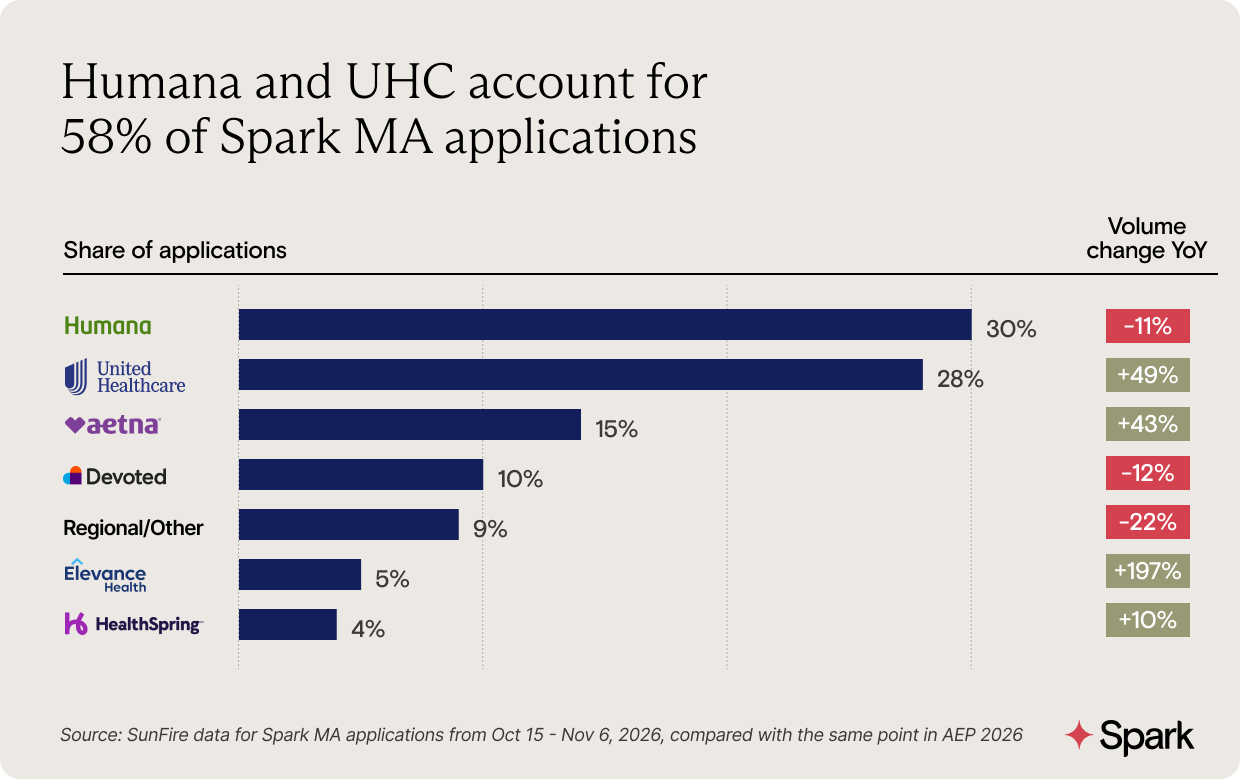
Humana’s plan cancellations affected more Spark clients than any other carrier’s. As a result, rewrites make up a larger share of its applications than any other national carrier’s (22%), as agents moved clients with cancelled plans to new Humana plans. In contrast, most of UHC’s applications come from Spark partner agents enrolling clients new to them (72%, the highest of any national carrier).
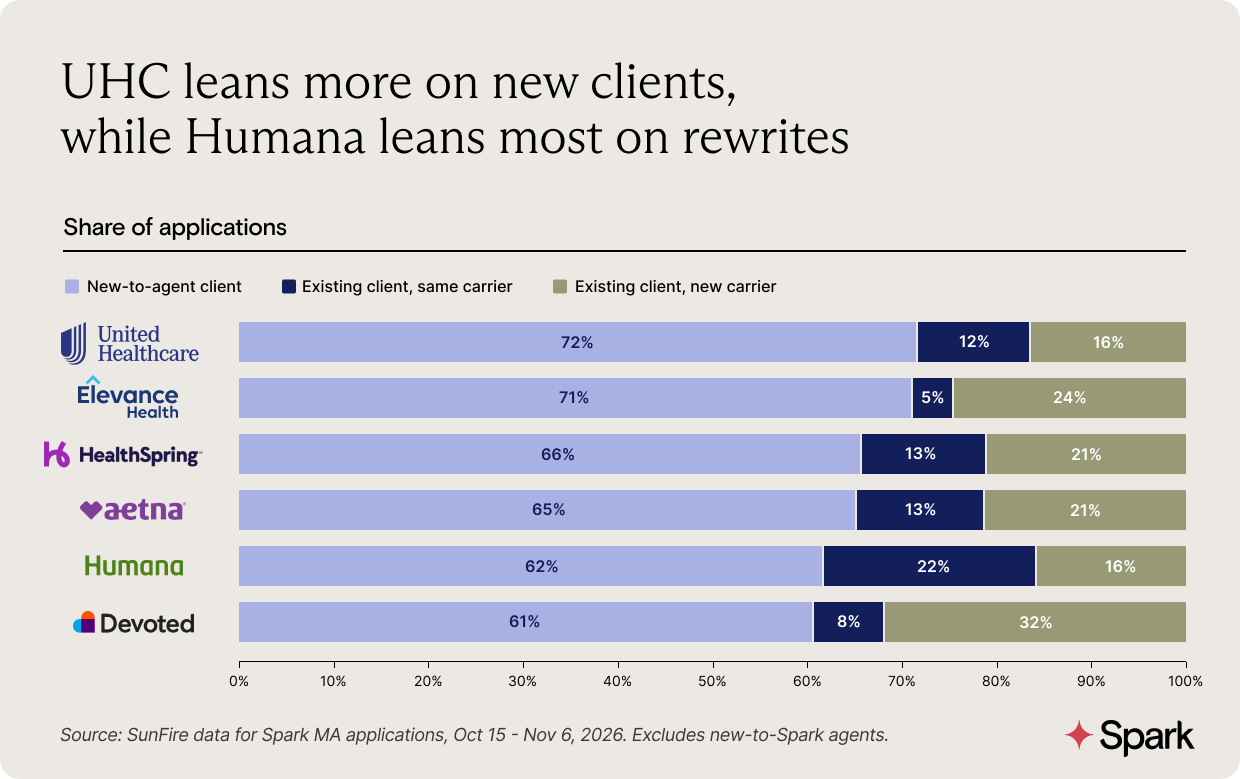
Many of those new UHC enrollments are with Special Needs Plans (SNPs). UHC is now the #1 carrier for both C-SNP (47%) and D-SNP (45%) applications submitted by Spark partner agents, while Humana leads Givebacks. Carriers are leaning into different products as they look for ways to grow more sustainably.


“The days of one carrier being the default answer for every client are over. Carriers are picking their lanes this year, and clients’ needs are just as varied, whether they’re dual-eligible, managing a chronic condition, or watching every dollar. With so much changing, agents are an essential resource for clients trying to make sense of their options.”
— James Jiang, CEO, Spark

“According to Spark’s insightful research we’re beginning to see how things are shaking out this AEP. One interesting data-point. There is less of a ‘clear winner’ in terms of enrollment growth this year. During the prior three AEPs one carrier clearly dominated enrollment growth. This year there seems to be a few carriers in the mix.”
— Jared Strock, Principal & Consulting Actuary, Medicare Market Insights
Cost increases are pushing more plan switchers to new carriers
Clients have been hit hard by big plan changes this year. The share of those facing plan cancellations tripled to 9%, impacting Givebacks, D-SNPs, and PPOs especially. Nearly half of all clients face a higher out-of-pocket maximum (MOOP) this year, with a median increase of $600.
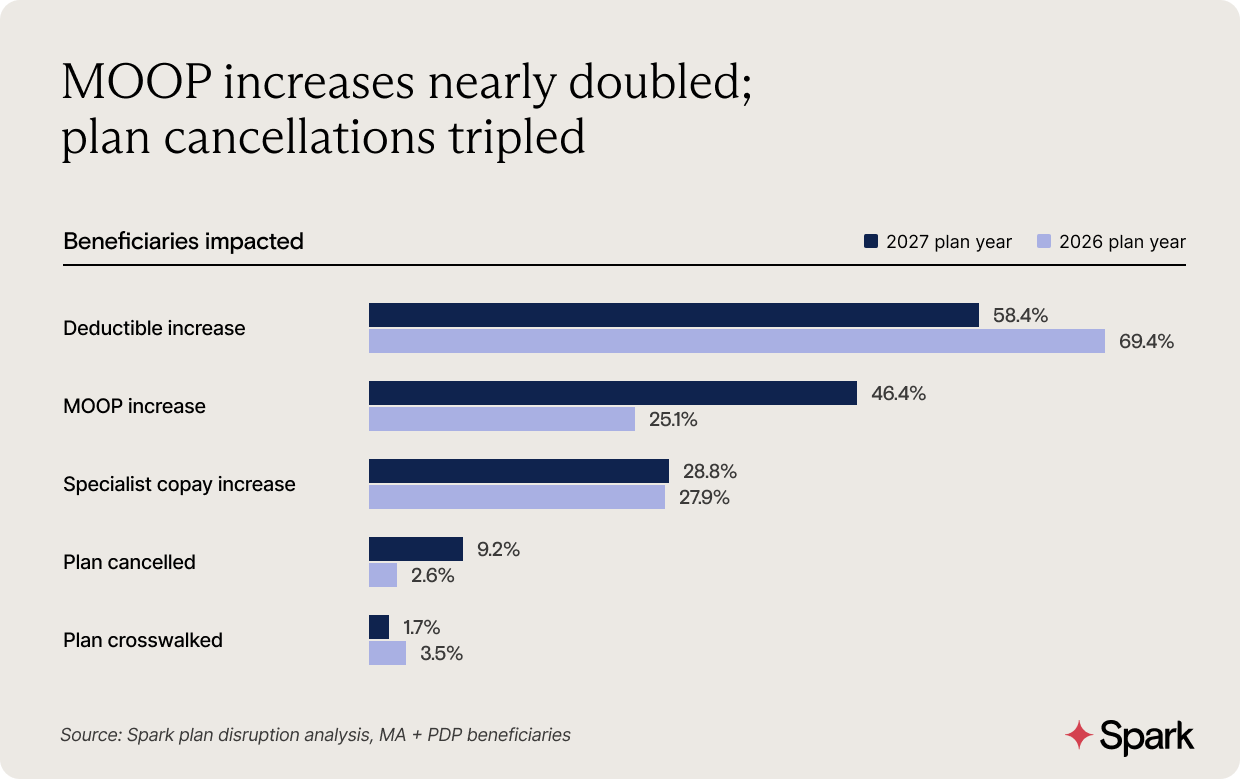
As a result, a larger portion of Spark applications are coming from clients with significant plan changes: 15% so far, up from 10% last year.
Not surprisingly, more of those applications are from beneficiaries with cancelled plans. Their share doubled, from 21% last year to 42%. They are switching the fastest, at 7x the rate of those with no plan changes.
Cost increases still account for the largest share of applications from those with plan changes (56%), and those applications are more likely to go to a new carrier: 60%, compared with 43% from clients with cancelled plans. For agents, that makes a conversation about cost a strong way to start a plan review.

“The MOOP number is something we are hearing a lot about. Premium changes and plan cancellations are felt immediately, but a $600 jump in out-of-pocket maximum is a benefit cut that most seniors won't feel until they actually get sick. Carriers who hoped that the MOOP increases would not drive member churn are learning that assumption is incorrect.”
— Sam Melamed, CEO, NCD

“Agents who have protected their clients against rising cost shares with products such as Critical Illness CHAS or Hospital Indemnity plans face less risk of churn because their clients are protected against these increases.”
— Jesse Hendon, Head of Life & Ancillary, Spark
Humana and Devoted are winning carrier switchers
Despite the broad changes to plans, many clients are sticking with their carriers this year and often choosing another plan from the same carrier when they switch. UHC is the most stable, with only 2.2% of its beneficiaries switching plans so far, the lowest of any major carrier. Humana is the only major carrier where beneficiaries are switching plans more than last year, due to the breadth of its plan cancellations.
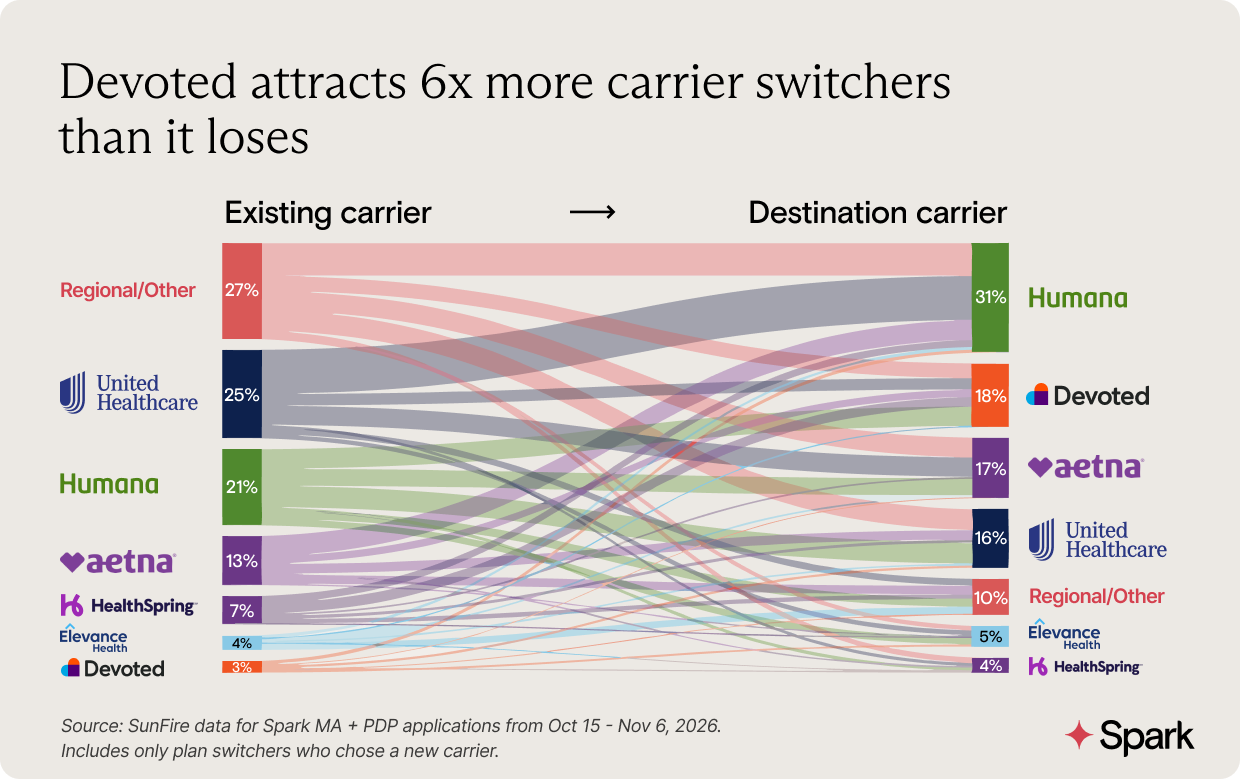
When people do switch carriers, they’re going to Humana and Devoted. In fact, Devoted attracts 6x more switchers than it loses, far more than any other carrier, as its reputation for value-based care grows and it enters new markets. In contrast, regional and smaller carriers are losing three members for every one they gain.

“Your book has been re-sorted, whether you act or not. Carriers are putting their best benefits into the segments they want to own. Plans outside those segments are getting thinner benefits and, often, higher costs. Sort your book the way the carriers sort theirs: pull it by carrier and plan type, find the members in a carrier's non-core plans, and review them first.”
— Nick Tatge, Head of Carrier Relations, Spark

“Cost is what moves people, which means retention is won in the review, not the renewal letter. The agents who reach their book before AEP with the changes already mapped out keep their clients, and they pick up the ones nobody called.”
— Justin Jacobs, Founder, Health Plan Markets
C-SNPs and HMOs replacing PPOs as MA’s growth engines
Plan disruptions are reshaping what people are enrolling in, too.
The PPO growth boom is officially over. More than 90% of PPO beneficiaries face a significant plan change this year, the most of any plan type, and they’re switching plans at the highest rate so far (5.4% vs 4.3% across all plan types). That holds even among those whose plans weren’t cancelled, suggesting many are actively shopping for better costs and benefits. Only 40% of PPO plan switchers are staying with a PPO, the lowest retention of any plan type, and most are moving to HMOs and Givebacks.
Giveback beneficiaries continue to switch at a high rate, driven by plan cancellations this year. But unlike PPOs, nearly two-thirds of Giveback switchers are staying with the plan type, as agents moved clients to replacement plans.
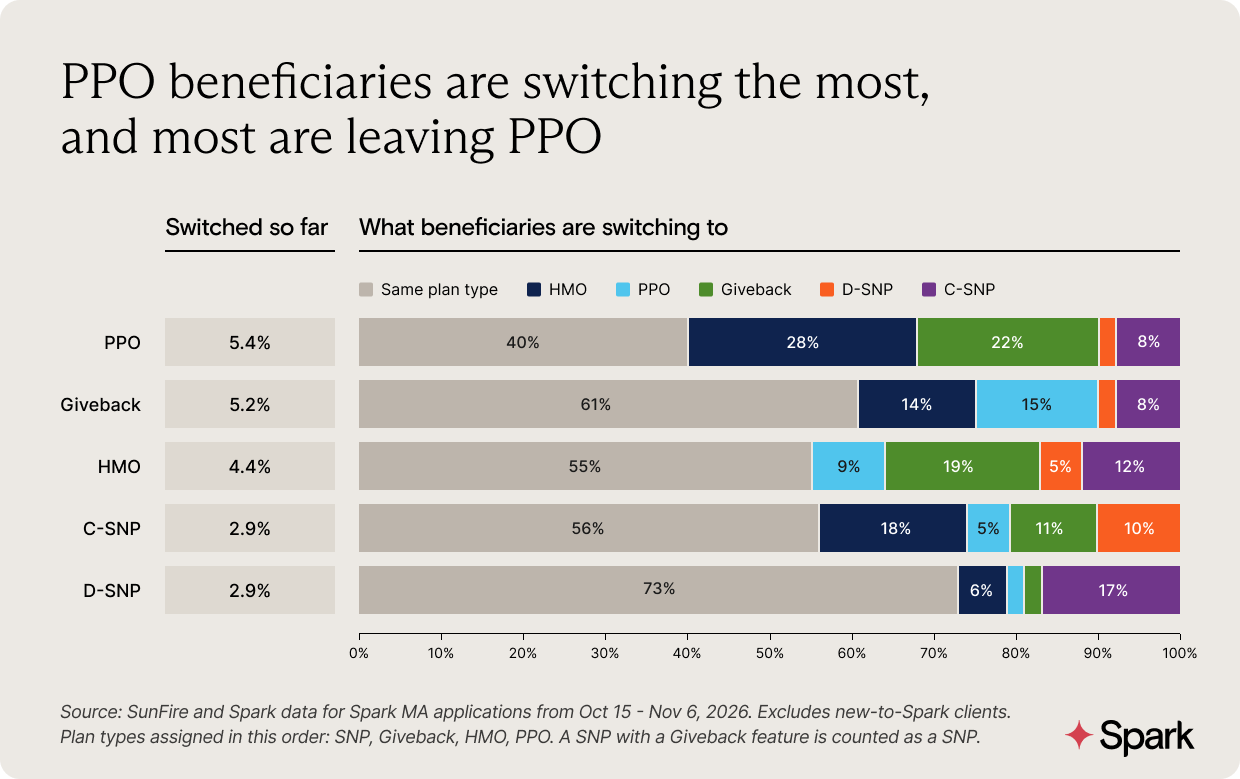
C-SNPs and HMOs are the only plan types gaining share so far, as carriers expand their offerings in both. C-SNPs are growing fastest: their share of Spark applications is up 30% from last year, and among plan switchers, they win three members for every one they lose, more than any other type, likely helped by tighter D-SNP rules. HMOs follow, with their share up 12%. HMOs now lead Spark MA applications at 27%, followed by Givebacks (24%), D-SNPs (21%), C-SNPs (15%), and PPOs (13%).

“C-SNPs with Givebacks are the perfect crossbreed for enhanced benefits for those who have a greater need. It just may be the ‘Perfect Medicare Advantage Plan’ in its design: the structure is sound, the funding is there and it plays to the strengths of the system we have and where it's going.”
— Brent Crawley, CEO, The Premier Agency
The mix is spread out at the plan level too, which is a good sign for enrollment quality, something carriers are scrutinizing more than ever. Even with fewer MA plans for beneficiaries to choose from this year, the top 20 plans that agents are writing make up the same share of applications as last year (13%) and no single plan makes up more than 3%. They suggest agents are doing their due diligence to find the right fit for each client rather than funneling them into a few plans.
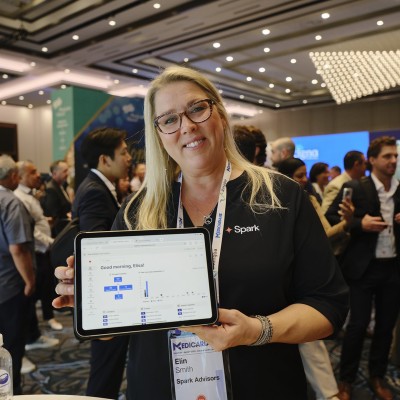
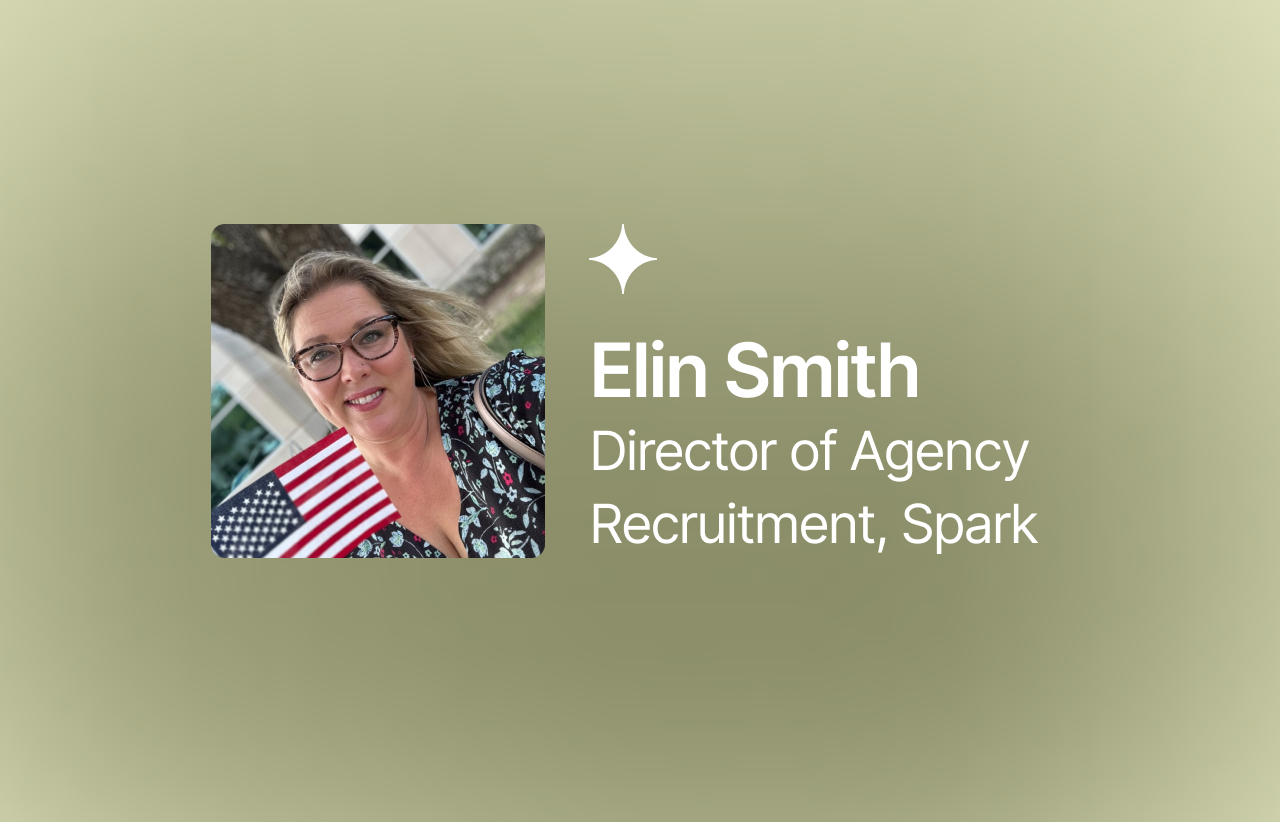
“Don't let the application be the end of the client conversation. Track application status, resolve outstanding issues, and make sure clients understand what happens next. Strong follow-through helps protect both the client experience and the business you've worked hard to write.”
— Elin Smith, Head of Agency Recruiting, Spark
AEP looks different in each market
Top markets are moving in different directions. That’s why agents who know their local carriers, plans, and enrollment requirements (especially SNPs) are so important in guiding clients through this year’s widespread changes.
Spark applications are up sharply in North Carolina, California, and Texas as carriers shift where and how they grow. UHC is gaining share in the South, rising from 22% to 32% of Spark applications. Meanwhile, Aetna is the clear leader in the Northeast. In the West, Devoted and regional carriers are gaining share, while in the Midwest, Elevance’s share has grown quickly.

So far, more than a quarter of Spark applications (27%) have come from existing clients, up from 19% last year at the same time. With the jump in plan cancellations and out-of-pocket costs this year, agents have prioritized helping current clients first. High advertising costs during election season likely deterred agents from marketing to prospective clients and added to that focus as well.

“Seniors have been inundated with political advertising, making them more difficult to reach. New agents may have the greatest opportunity to capitalize on the current disruption. Reaching seniors remains the key challenge, so I recommend focusing on grassroots marketing and building partnerships with providers.”
— Dustin VanDuine, Rick Young Insurance
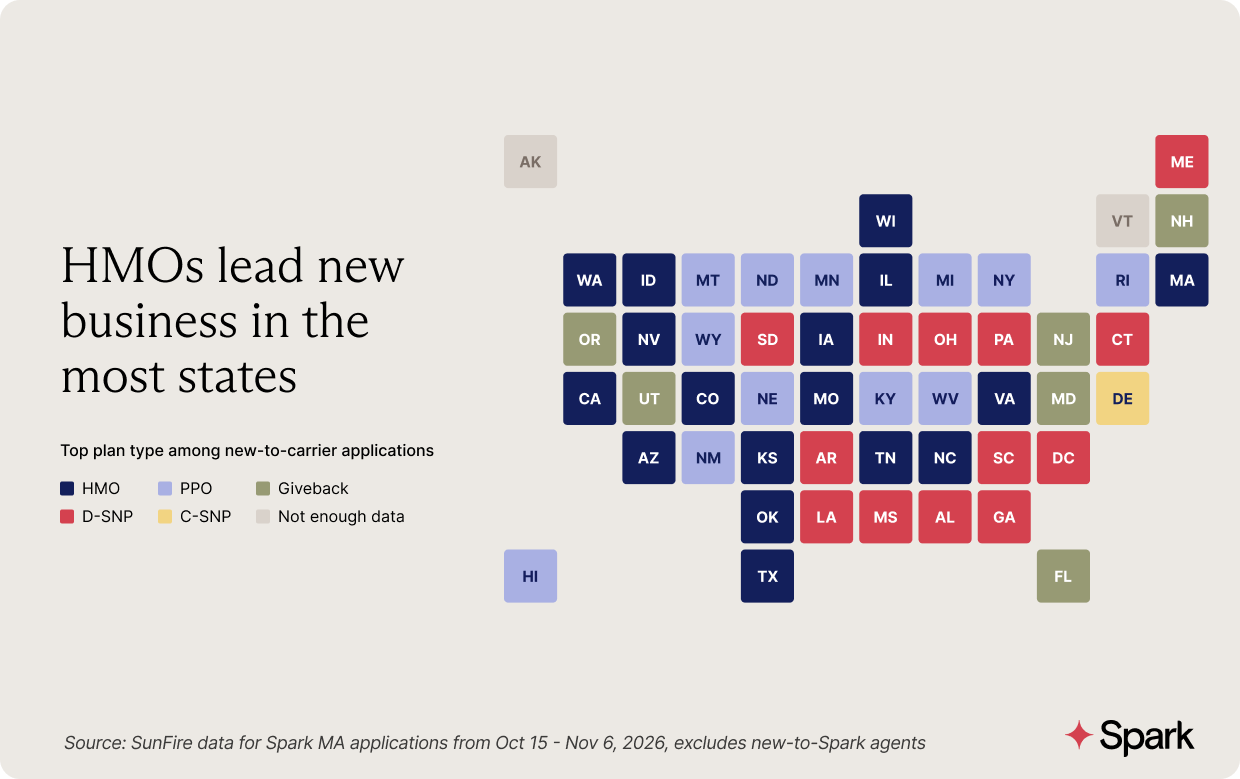
As AEP’s second half gets underway, new business is expected to pick up, but in different ways than last year. In Florida, Givebacks have replaced D-SNPs as the top plan type for new business, even after setting aside the clients agents moved to new Giveback plans after Humana’s cuts. In Texas, HMOs now lead, but C-SNPs have nearly doubled their share of new business (16%, up from 9%). And in Michigan, PPOs make up 56% of new business, almost 3.5x their national share.

“Many of the trends Spark has identified reinforce what we’re seeing firsthand across our business. Success today isn’t simply about driving more volume; it’s about understanding your economics, leveraging real-time data, delivering a great consumer experience, and having the discipline to react quickly to changing market conditions.”
— Keith Mendonsa, Co-Founder/CEO, Silver Health Advisors
Strategies for AEP's second half
Our data makes it clear: many beneficiaries still need enrollment help this AEP. With so many changes to Medicare plans, and fewer to choose from, finding the right coverage is more complicated than ever.
This is exactly why Medicare agents matter. Across the country, they’re putting in long hours to understand each client’s needs, explain what’s changed with plans, and find one that fits.
Spark is here to help. Our top advice for agents for the second half:
- Keep working plan cancellations and cost increases. Clients with cancelled plans are moving fast. Many facing higher out-of-pocket costs haven’t shopped yet.
- Help clients bridge higher out-of-pocket costs. With nearly half facing a higher MOOP, ancillary coverage like hospital indemnity, critical illness, and cancer/heart attack/stroke (CHAS) plans can help clients manage the extra expenses.
- Expect volume to pick up and mix to shift: Giveback volume should ease as resales of exited plans wrap up. C-SNPs, already gaining the most share, should pick up further now that the election is over.
- Make sure plans will effectuate. Carriers are acting on quality, not just tracking it. Agency leaders should watch for early warning signs of non-compliant behavior, such as abnormal application velocity, high plan concentration, and poor call scores.
- Double down on what’s working. The second half of AEP is for writing business, not fixing what’s broken. If a lead vendor isn’t delivering, drop it. If a market isn’t producing, focus on the ones where you’re already closing.
Want to see how agents are pacing your market? Our AEP Production Benchmarks dashboard tracks state-level production volume, which plan types are trending, and which carriers agents are writing with. Or book a free 15-min consultation for more insights into your market and where to focus for the rest of AEP. Let’s finish strong!
Special thanks to Alex Peters Van Aalst, Amy Edwards, Nick Tatge, and Jordan Greene for their insights.
About the data: Application figures reflect Spark applications submitted Oct 15 – Nov 6, 2026 based on SunFire, carrier reports, and Spark platform data. SunFire captures most but not all Spark applications, so figures may differ slightly from a complete count.